The Vraat'Kesh are a hexapodal, radiotrophic species native to Piedra Saotine in the Omicron Caelus system. Classified biologically as Modified Chordates, they possess a central spinal axis and internal calcium-bone framework, but lack an upper limb girdle—their hydrostatic upper limbs anchor directly to thoracic muscular plates. Adapted to a low-gravity (0.752 g) and high-ultraviolet environment, they feature a quadrupedal lower body, an elongated upper torso, an obsidian melanin integument, and two morphic limbs.
¶ Physical Characteristics
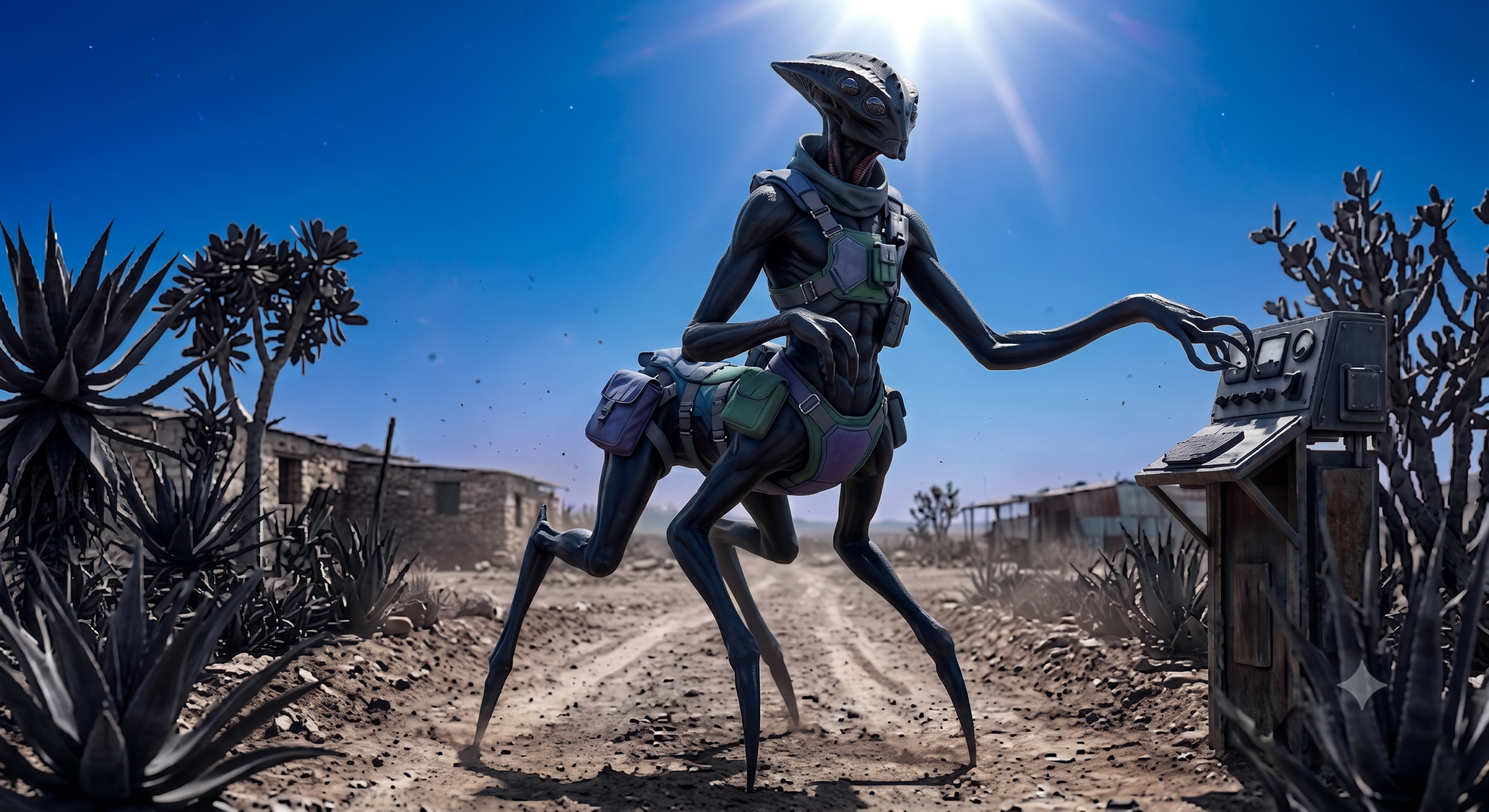
The Vraat'Kesh are Modified Chordates adapted to low gravity () and high-ultraviolet environments. They possess a central spinal column and internal calcium-bone framework, but lack a shoulder girdle. Their upper limbs anchor directly to thoracic muscle plates.
¶ Sexual Dimorphism & Stature
- Females: Stand 2.5 to 2.6 meters tall with a heavier, broader frame. The cephalic dome is wide and rounded, reinforced with thick calcium shielding to protect the braincase during reproduction. The pelvic ring is wider, lowering the center of gravity and accommodating internal brood plates.
- Males: Stand 2.2 to 2.35 meters tall with a leaner, more compact frame. The cephalic dome forms a narrow, wedge-shaped crest with bone ridges. The compact pelvic ring allows for longer stride length and faster acceleration.
¶ Integument & Skin Mechanics
The skin is entirely opaque (not translucent), smooth, and charcoal-black to jet-obsidian. It is extremely flexible, stretching and shifting smoothly over the muscular hydrostats and torso without tearing or binding. High concentrations of sub-dermal radiotrophic melanin convert ultraviolet radiation into metabolic bio-energy. Females maintain a higher baseline melanin density across the torso for energy storage during egg development, while males possess permanent, high-contrast iridescent UV bands along the chest and neck.
¶ Sensory Systems
- Multispectral Vision: Four optical domes perceive a continuous spectral band from (ultraviolet) to (thermal infrared). Visual resolution is wavelength-dependent: shorter UV wavelengths () yield crisp, high-detail imagery, whereas longer thermal IR wavelengths () provide lower-resolution heat-gradient mapping. Female vision leans toward thermal IR detection; male vision emphasizes short-wave UV precision.
- Atmospheric & Acoustic Vibration: Paired membrane-lined fissures on the throat and mid-torso detect pressure waves and acoustic vibrations moving through Piedra Saotine’s dense atmosphere. Females generate low-frequency vocal vibrations (); males project high-frequency clicks and sibilant signals ().
- Substrate Seismic Vibration: Micro-receptors situated at the joints between the internal leg bones and terminal stylets detect ground-borne vibrations through rock or architectural metal grates.
- Electroreception: Specialized bio-electric pits housed in the upper limbs detect micro-electrical currents from machinery or living nervous systems.
- Radiotrophic Photoreception: Epidermal melanin clusters passively monitor ambient UV levels, giving the organism an unconscious sense of solar exposure and radiation density.
- Micro-Spatial Tactile Sense: High-density mechanoreceptors at the tips of the upper limbs read surface textures down to the microscopic level.
- Proprioception & Vestibular Balance: Inner-ear fluid canals inside the skull dome, combined with leg-muscle stretch receptors, maintain orientation and balance in low gravity.
- Ventral Chemoreception: Receptor pits inside the acoustic fissures and ventral pouch sample airborne chemical compounds, pheromones, and environmental hazards.
¶ Upper Appendages & Functional Modes
The upper body features two bone-free muscular hydrostatic limbs with rotational freedom. They operate via fluid pressure and dense helical muscle fibers across four primary functional modes:
- Default Mode: Hangs as smooth, flexible tendrils capable of wide sweeping motions.
- Precision Hand Mode: The limb tip splits into micro-tentacles that braid into multi-fingered hands with opposing thumb structures. Male limb tips contain higher local nerve density for fine technical work; female limbs generate higher torque and load capacity.
- Sensor Node Mode: The tip swells into a bulbous dome, bringing electro-receptors and thermal sensors to the surface.
- Interface Paddle Mode: The limb flattens into a rigid spatula used to press control surfaces, manipulate soft materials, or physically shield vulnerable body regions.
¶ Lower Chassis & Locomotion
Four spindly legs extend from the pelvic ring in a wide stance. Each leg contains internal long bones connected by two major hinge joints, forming a Z-shaped profile that absorbs landing impacts. The legs taper down to chitin-bone stylets consisting of a porous calcium bone core wrapped in a hard, jet-black chitin sheath. Female stylets are blunter to lock into nesting substrates and structural grates; male stylets are longer and needle-sharp.
¶ Internal Architecture
A central spine connects the cephalic dome directly to the pelvic ring, housing the main nervous cord without any upper bone girdle. Internal organs are packed tightly within the elongated torso.
¶ Life Cycle
- Reproduction: TBD
- Gestation & Hatching: TBD
- Development & Aging: Early life stages transition into adult pigmentation as melanin saturates the epidermis and lower limb stylets calcify. Lifespan is TBD.
¶ Personality and Traits
- Behavioral Patterns: TBD
- Mental & Emotional Profile: TBD
¶ Subsections on Traits
- Environmental Sensitivity: Highly responsive to thermal changes, UV exposure levels, and atmospheric vibrations.
¶ Culture and Society
- Social Structure: TBD
¶ Gender Roles
Biological function is hermaphroditic/non-binary; functional roles in society are based on physical or technical specialization rather than biological gender.
¶ Community Values
- Structural Integration: Architecture and equipment are designed to interface directly with morphic limbs and point-contact stylets.
¶ Romance, Courtship, and Love
- TBD
¶ Family
- TBD
¶ Cultural Norms and Habits
- Grating Floors: Interior architecture uses micro-perforated or slotted metal grates to accommodate chitin-bone stylets for stability.
- Illumination: Standard visible lighting is ineffective for Vraat'Kesh vision; environments are lit via thermal or UV emissions.
¶ Special Abilities
- Radiotrophic Synthesis: Direct absorption and conversion of UV radiation into metabolic energy.
- Hydrostatic Metamorphosis: Dynamic reshaping of upper limbs into tools, hands, sensory nodes, or flat interface surfaces.
- Multispectral Vision: Dual perception across thermal infrared and ultraviolet wavelengths.
- Point-Lock Stability: Chitin-bone stylets allow mechanical locking into perforated substrates.
¶ Economics
- Economic System: TBD
¶ Subsections on Currency and Exchange of Goods
- TBD
¶ Subsections on Distribution of Wealth and Resources
- TBD
¶ Politics
- Governance: TBD
¶ Subsections on How Laws Are Made
- TBD
¶ Subsections on How Treaties and Agreements Are Made
- TBD
¶ Law and Justice
- Legal Framework: TBD
¶ Enforcement
- TBD
¶ Judicial System
- TBD
¶ Spiritual Beliefs
- Belief System: TBD
¶ Values and Practices
- TBD
¶ Important Holidays
- TBD
¶ Rituals and Practices
- TBD