Void Space, commonly called The Void, is the infinite interstitial demiplane connecting all realities and dimensions. While its outer expanses operate under chaotic, non-standard physics, it centers on a stable, localized pocket of spacetime harboring a single planetary system. Moving through the Void transitions matter and energy between the physical laws of distinct realities.
¶ The Architecture of the Void
The demiplane is structured into two distinct regions: a stable interior zone and the interstitial expanse surrounding it.
¶ The Central Core
The interior contains a 10-lightyear diameter spheroid zone where spacetime behaves normally and adheres to standard physical laws. At the center sits the Well of Forever, a spacetime distortion connected to all realities simultaneously. The Well radiates heat and illumination, acting as the primary star of this core system, designated Selencia.
¶ The Breakdown of Physics
Beyond the 10-lightyear threshold, spacetime distorts and compresses, causing time dilation relative to the core. Normal physical forces decay without a defined boundary:
- Gravity and Electromagnetism: The first interactions to experience disruption.
- The Weak and Strong Forces: Behave erratically at greater distances, causing mass and energy to mutate into exotic configurations rather than dissipating.
- Chaotic Mapping: Spatial compression causes points across realities to map unpredictably into the outer expanse, frequently looping spacetime back onto itself to form natural spatial barriers.
¶ Void Matter, Energy, and Entities
As conventional physics breaks down outside the core, native properties of the interstitial realm emerge.
¶ Void Energy
Energy in the outer expanse exists as the absence of conventional spacetime metrics. Harnessing this energy allows reality manipulation calibrated to a target universe's physical laws.
¶ Void Matter
Matter drifting beyond the safe zone is composed of condensed void energy, manifesting as a field of varying particle density that shifts between a quasi-liquid and pure energy state. Objects traversing the space collect residual particles.
¶ Multiversal Life
While standard matter is rare outside the core, void energy can coalesce into complex forms. The outer void harbors native life forms and subspace structures, some capable of influencing bordering realities. Cosmological theories link organic life cycles directly to Void energy, proposing that living consciousness draws from and returns to the realm upon birth and death.
¶ Transitioning into Void Space
Entering or leaving requires traversing a subspace rift, wormhole, or gate linking the interstitial void with normal spacetime.
¶ Uncontrolled Transitions
Accidental transitions risk structural destruction. Ambient energy from incoming rifts is absorbed into the void, while physical matter is drawn toward the core, usually materializing near the 10-lightyear boundary. Vessels lose external power grids upon crossing, though self-contained chemical or nuclear reactions still generate localized power. Artificial quantum singularities remain inherently unstable and will rupture or dissolve upon entry.
¶ Controlled Methods of Entry
Access protocols require Level 6 clearance due to operational security risks:
- Hermod Gate: The primary entry method. Operatives access classified Janus Coordinates (via Vertex Scanner or secure drive) to dial a Stargate, placing travelers outside The Vault on Erebusa.
- Dimensional Fold Drive (DFD): Vessels equipped with a DFD can transition directly into the core. The drive calibration mimics a catastrophic engine failure and is restricted to emergency use.
- Magical Transition: Capable mages can enter The Vault directly using attuned mirrors anchored to the material plane.
¶ Selencia Star System
| Property | Value | Image |
|---|---|---|
| Type | F4IV Yellow-White Subgiant Star | 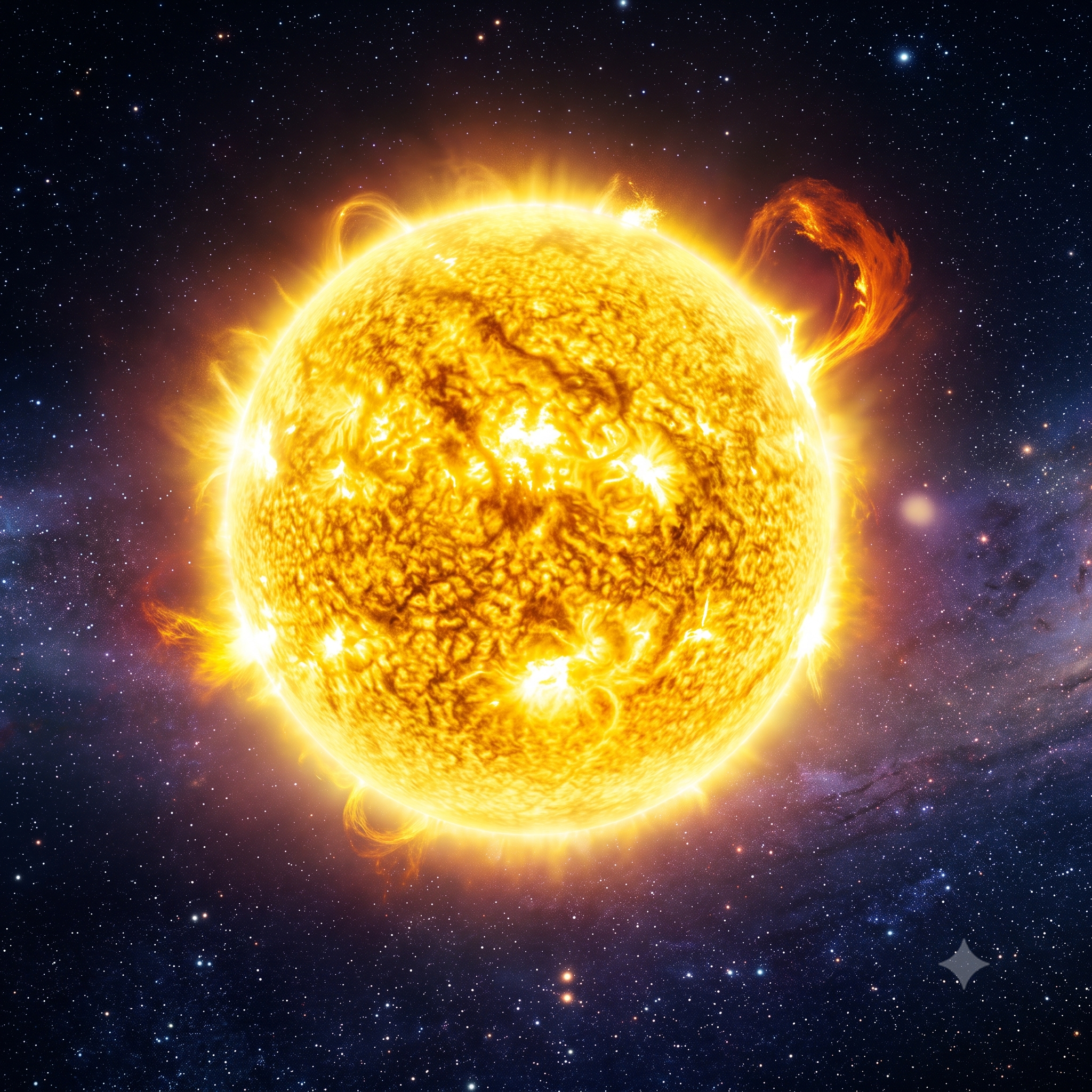 |
| Radius | 9.24 × 10⁵ km | |
| Mass | 8.93 × 1030 kg (4.5× Sol) | |
| Temperature | 6900 K | |
| Luminosity | 1.38 × 1027 W (3.6× Sol) | |
| Habitable Zone | Between 1.81 and 2.61 AU | |
| Location | Void Space |
The star is approximately 2.22 billion years old, with an expected lifespan of 2.32 billion years and possesses a main-sequence habitable zone lifespan spanning between 2 and 4 billion years, which provides sufficient time for complex biospheres to emerge, including advanced UV-shielding and biofluorescent adaptations.
This system contains 3 planets, 1 asteroid belt, and 12 moons. There are 2 class M world in the system. The star's stellar wind creates a bubble, known as the heliosphere, which extends out to approximately 361.2751 AU. Beyond this, the star's gravitational influence extends out to a distance of 2.82 light-years, marking the ultimate edge of the system.
¶ Nyxia
| Property | Value |
|---|---|
| Class | M |
| Distance | 1.230 AU |
| Period | 1 years 322 days 15 hours and 58 minutes |
| Radius | 5,512.71 km |
| Gravity | 0.762 g |
There are 6 moons orbiting this planet. This planet has a surface pressure of 108.3 kPa or 1.07 atmospheres and a temperature of 10.8 degrees C. It is a terrestrial earth-like world with an atmosphere of a mix of oxygen, nitrogen, and argon and a composition of silicon, iron, and magnesium. The planet's conditions are suitable for the development of life based on blue-optimized porphyrins, which is expected to evolve at a normal. The visible reflection spectrum of the life on this planet is characterized by red, orange, yellow, biofluorescent green, biofluorescent red. In the non-visible spectrum, it exhibits blue-shifted vegetation edge, strong uv absorption.
A speculative evolutionary timeline for a planet orbiting this star indicates an evolutionary pace described as standard. The current estimated age of the system is 1.69 Billion Years. The planet has lush vegetation and simple animal life.
¶ Traumnem Emelpona
| Property | Value |
|---|---|
| Class | D |
| Distance | 4.1976 × 10⁶ km |
| Period | 1 day 17 hours and 12 minutes |
| Radius | 291.61 km |
| Gravity | 0.044 g |
This moon has no atmosphere and a surface temperature of -43.0 degrees C. It is a small icy body with a composition of frozen hydrocarbons and ice.
¶ Tidakomax
| Property | Value |
|---|---|
| Class | D |
| Distance | 4.3979 × 10⁶ km |
| Period | 1 day 20 hours and 11 minutes |
| Radius | 477.65 km |
| Gravity | 0.064 g |
This moon has no atmosphere and a surface temperature of -43.8 degrees C. It is a small icy body with a composition of frozen hydrocarbons and ice.
¶ Lisidhena
| Property | Value |
|---|---|
| Class | D |
| Distance | 7.9546 × 10⁶ km |
| Period | 4 days 11 hours and 29 minutes |
| Radius | 54.5 km |
| Gravity | 0.008 g |
This moon has no atmosphere and a surface temperature of -40.2 degrees C. It is a small icy body with a composition of frozen hydrocarbons and ice.
¶ Whisn Nrgula
| Property | Value |
|---|---|
| Class | D |
| Distance | 9.1520 × 10⁶ km |
| Period | 5 days 12 hours and 38 minutes |
| Radius | 425.47 km |
| Gravity | 0.053 g |
This moon has no atmosphere and a surface temperature of -37.0 degrees C. It is a small icy body with a composition of frozen hydrocarbons and ice.
¶ Mindina
| Property | Value |
|---|---|
| Class | D |
| Distance | 9.1864 × 10⁶ km |
| Period | 5 days 13 hours and 23 minutes |
| Radius | 128.42 km |
| Gravity | 0.015 g |
This moon has no atmosphere and a surface temperature of -45.4 degrees C. It is a small icy body with a composition of frozen hydrocarbons and ice.
¶ Pildrb Rynhix
| Property | Value |
|---|---|
| Class | D |
| Distance | 9.2756 × 10⁶ km |
| Period | 5 days 15 hours and 20 minutes |
| Radius | 417.39 km |
| Gravity | 0.056 g |
This moon has no atmosphere and a surface temperature of -41.9 degrees C. It is a small icy body with a composition of frozen hydrocarbons and ice.
¶ Erebusa
| Property | Value |
|---|---|
| Class | M |
| Distance | 2.60 AU |
| Period | 9 years 35 days 10 hours and 54 minutes |
| Radius | 6,991.29 km |
| Gravity | 0.962 g |
There are 6 moons orbiting this planet. This planet has a surface pressure of 106.2 kPa or 1.05 atmospheres and a temperature of 12.2 degrees C. It is a terrestrial earth-like world with an atmosphere of a mix of oxygen, nitrogen, and argon and a composition of silicon, iron, and magnesium. The planet's conditions are suitable for the development of life based on blue-optimized porphyrins, which is expected to evolve at a normal. The visible reflection spectrum of the life on this planet is characterized by red, orange, yellow, biofluorescent green, biofluorescent red. In the non-visible spectrum, it exhibits blue-shifted vegetation edge, strong uv absorption.
A speculative evolutionary timeline for a planet orbiting this star indicates an evolutionary pace described as standard. The current estimated age of the system is 1.37 Billion Years. The planet has lush vegetation and simple animal life.
The planet houses artificial structures of unknown origin that defy radiometric dating:
- Firmamentum Saeculorum: The primary structure, inscribed with symbols resembling proto-European dialects.
- Verum Transitus: Located several miles away. Rune-carved standing stones north of the primary structure teleport individuals here upon command.
- The Gate Site: Solas Tempus operates a Hermod Gate near the Firmamentum Saeculorum. It requires a direct interface or remote system (such as a Tricorder, PADD, or Vertex Scanner) to dial.
¶ Anirato
| Property | Value |
|---|---|
| Class | D |
| Distance | 2.5100 × 10⁶ km |
| Period | 19 hours and 3 minutes |
| Radius | 314.62 km |
| Gravity | 0.039 g |
This moon has no atmosphere and a surface temperature of -104.2 degrees C. It is a small icy body with a composition of frozen hydrocarbons and ice.
¶ Anihildri
| Property | Value |
|---|---|
| Class | D |
| Distance | 9.4325 × 10⁶ km |
| Period | 5 days 18 hours and 47 minutes |
| Radius | 329.37 km |
| Gravity | 0.042 g |
This moon has no atmosphere and a surface temperature of -101.2 degrees C. It is a small icy body with a composition of frozen hydrocarbons and ice.
¶ Siliathayx
| Property | Value |
|---|---|
| Class | D |
| Distance | 1.9729 × 10⁷ km |
| Period | 17 days 11 hours and 50 minutes |
| Radius | 272.18 km |
| Gravity | 0.035 g |
This moon has no atmosphere and a surface temperature of -96.1 degrees C. It is a small icy body with a composition of frozen hydrocarbons and ice.
¶ Mirpsi Rechote
| Property | Value |
|---|---|
| Class | D |
| Distance | 2.0561 × 10⁷ km |
| Period | 18 days 14 hours and 40 minutes |
| Radius | 363.11 km |
| Gravity | 0.054 g |
This moon has no atmosphere and a surface temperature of -104.9 degrees C. It is a small icy body with a composition of frozen hydrocarbons and ice.
¶ Sognpek Ollikox
| Property | Value |
|---|---|
| Class | D |
| Distance | 2.0669 × 10⁷ km |
| Period | 18 days 18 hours and 11 minutes |
| Radius | 125.79 km |
| Gravity | 0.019 g |
This moon has no atmosphere and a surface temperature of -100.6 degrees C. It is a small icy body with a composition of frozen hydrocarbons and ice.
¶ Pixcapusa
| Property | Value |
|---|---|
| Class | D |
| Distance | 2.0734 × 10⁷ km |
| Period | 18 days 20 hours and 17 minutes |
| Radius | 346.79 km |
| Gravity | 0.053 g |
This moon has no atmosphere and a surface temperature of -95.5 degrees C. It is a small icy body with a composition of frozen hydrocarbons and ice.
¶ Hecatia
| Property | Value |
|---|---|
| Class | P |
| Distance | 3.305 AU |
| Period | 4 years 82 days 17 hours and 45 minutes |
| Radius | 2,434.75 km |
| Gravity | 0.783 g |
There are 6 moons orbiting this planet. This planet has a surface pressure of 99.1 kPa or 0.97 atmospheres and a temperature of -92.1 degrees C. It is a terrestrial earth-like world with an atmosphere of a mix of oxygen, nitrogen, and argon and a composition of silicon, iron, and magnesium. The planet's conditions are not suitable for life and there is none on this planet.
A world covered in permafrost glaciers. Surface ruins suggest ancient terrestrial habitation, anchored by an intact artificial structure known as the Arcane Sanctuary.
¶ Asteroid Belt
An asteroid belt orbits roughly between 22.323 AU and 27.579 AU. This is a sparse asteroid belt, composed of high concentrations of magnesium, moderate concentrations of fluoranthene, small concentrations of schreibersite, and trace amounts of xenotime.
¶ The Starships Graveyard
A dense sector within the safe zone containing thousands of derelict spacecraft and stations trapped after disabling transit failures lies just outside the asteroid belt in ring around the system.
¶ Creation and Origins
There is no definitive record of how the stable interior core came to exist within the interstitial Void. Theories propose the 10-lightyear safe zone was engineered to act as a stable multiversal nexus, supported by the undatable monuments on Erebusa and Hecatia. However, empirical study of the realm's broader structure remains hindered by the decay of physical laws beyond the core boundary.